


Africa’s radio astronomy pipeline has a persistent problem: the continent builds telescope infrastructure faster than it trains the personnel to use it. Ghana commissioned its 32-metre converted telecommunications antenna at Kutunse in 2017, the first of eight African Square Kilometre Array (SKA) partner countries to complete such a conversion, yet the pool of researchers across the continent with hands-on radio interferometry and data-reduction skills remains limited. South Africa’s MeerKAT telescope, one of the world’s most sensitive radio arrays, generates data volumes that outpace the number of African scientists equipped to analyse them. The African Very Long Baseline Interferometry Network (AVN), which links radio telescopes across Botswana, Ghana, Kenya, Madagascar, Mauritius, Mozambique, Namibia, and Zambia into a continent-scale instrument, requires a regional workforce that does not yet exist at the scale needed.
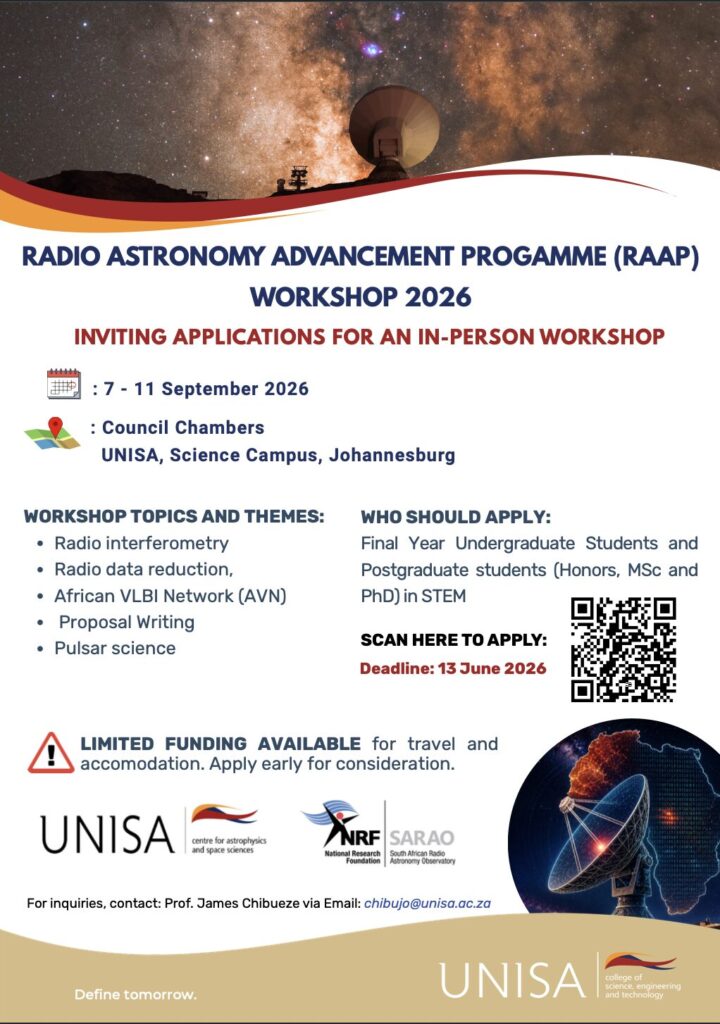
Building that workforce is the stated mandate of the Radio Astronomy Advancement Programme (RAAP), administered by the South African Radio Astronomy Observatory (SARAO), a national facility of the National Research Foundation (NRF). RAAP funds workshops designed to develop skills in radio astronomy science and engineering across South Africa and SKA partner countries. In 2026, one such workshop is being hosted by the University of South Africa (UNISA), with applications open until 13 June 2026.
The Workshop
The RAAP Workshop 2026 runs from 7 to 11 September at the Council Chambers on UNISA’s Science Campus in Johannesburg. It is a five-day in-person programme covering five technical areas: radio interferometry, radio data reduction, the African VLBI Network (AVN), proposal writing, and pulsar science.
Each topic addresses a specific gap in the African radio astronomy training pipeline. Radio interferometry and data reduction are foundational skills for working with multi-antenna telescope arrays, including MeerKAT and the eventual SKA, where raw data from multiple dishes must be combined and calibrated before any science can be extracted. AVN training is directly relevant to operating and contributing to the continent-wide telescope network that links Ghana, South Africa, and six other partner countries. Proposal writing addresses a different but equally practical gap: African researchers are underrepresented in the competitive process of securing telescope time on major international facilities. Pulsar science, the study of rapidly rotating neutron stars, is one of the high-priority research areas for the SKA and a field in which African astronomers have growing involvement.
Who Is Eligible
The workshop targets final-year undergraduate students and postgraduate students at Honours, MSc, and PhD levels in STEM fields. RAAP guidelines require that no more than 30% of participants come from the host institution and that gender balance and diversity be considered during participant selection, both of which apply to this workshop.
Limited funding is available for travel and accommodation. The application deadline is 13 June 2026. Applications are submitted via the official link, and inquiries should be directed to Prof. James Chibueze at chibujo@unisa.ac.za.
The Host Institution and Lead Academic
UNISA, the University of South Africa, is one of the largest distance-learning universities on the continent and home to the UNISA Centre for Astrophysics and Space Sciences (UCASS). Its astronomy group works across radio astronomy, star formation, galaxy evolution, and cosmology, using facilities including MeerKAT, the Very Large Array (VLA), the Atacama Large Millimetre/Submillimeter Array (ALMA), and the European VLBI Network (EVN).
The workshop is led by Prof James Chibueze, Distinguished Professor in the Department of Mathematical Sciences within UNISA’s College of Science, Engineering and Technology. Chibueze holds a PhD in Radio Astronomy and Astrophysics from Kagoshima University, Japan, and has published over 100 peer-reviewed papers. His research covers masers in galactic star-forming regions, astrometry, radio galaxies, galaxy clusters, and high-fidelity imaging with radio interferometers. He is a Vice President of the International Astronomical Union (IAU), co-chair of the Science Committee of the African Astronomical Society (AfAS), a member of SARAO’s Users Committee, and a member of the e-MERLIN (enhanced Multi Element Remotely Linked Interferometer Network) Steering Committee. He is also a recipient of the Royal Society Rising Star Africa Prize.
Key Details
- Application deadline: 13 June 2026
- Workshop dates: 7 – 11 September 2026
- Venue: Council Chambers, UNISA Science Campus, Johannesburg
- Contact: Prof. James Chibueze – chibujo@unisa.ac.za
- Funding: Limited travel and accommodation support available, early application advised
Click here to get real time data and information on every Segments and players in the African space and satellite industry.