


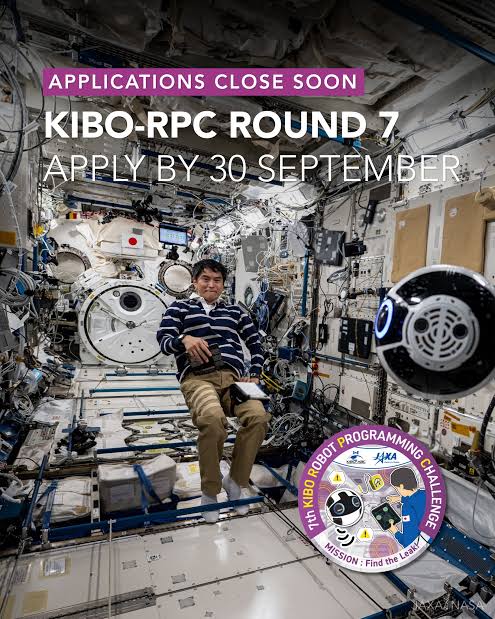
The United Nations Office for Outer Space Affairs (UNOOSA) is taking registrations for its international slot in the 7th round of the Kibo Robot Programming Challenge (Kibo-RPC). The deadline is Wednesday, 30 September 2026, at 16:59 CEST (UTC+2). Each course takes a maximum of 50 teams, and UNOOSA may close registration early if demand is high.
The Japan Aerospace Exploration Agency (JAXA) has run Kibo-RPC since 2020 under the Asian Beneficial Collaboration through Kibo Utilisation (Kibo-ABC) initiative of the Asia-Pacific Regional Space Agency Forum (APRSAF). UNOOSA and JAXA later partnered to open the challenge to students outside the Kibo-ABC countries. Students write code to move free-flying robots in a simulator. The best Regular Course teams then run their programs on real robots inside Kibo, the Japanese Experiment Module on the International Space Station (ISS).
This year’s mission is called “Crisis on the ISS.” Teams programme Int-Ball2, JAXA’s free-flying camera robot, to investigate a suspected air leak in Kibo. The robot must reach a series of checkpoints and read the AR markers at each one to collect inspection data, then finish at a goal point.
Two courses
UNOOSA offers two courses in this round. The Regular Course leads to the final round on the ISS. The Beginner Course is new for younger students: it is open to students under 16 (junior high school and below) as of 2026, and it runs only in the simulator, so these teams cannot reach the ISS final. Students can enter both courses if they meet the eligibility rules for each.
Who can apply
The UNOOSA slot is only for students in developing economies and economies in transition whose countries or regions are not already Kibo-RPC participants. UNOOSA decides eligibility using the country classifications in the UN Department of Economic and Social Affairs’ World Economic Situation and Prospects 2026. The Kibo-ABC participants are Australia, Bangladesh, Cambodia, Indonesia, Japan, Malaysia, Nepal, the Philippines, Singapore, Taiwan, Thailand and Vietnam, and none of them is in Africa. That makes the UNOOSA slot the entry point for African student teams.
In both courses, teams need three to six members, including at least three students. Only the team leader or representative may be a non-student.
How selection works
Accepted teams get login details for JAXA’s web-based simulator, which is due for release in October 2026. In the Regular Course preliminary round, UNOOSA teams submit their code through the simulator. They also email a short PowerPoint presentation (one title slide and up to five content slides) that covers four points:
- Why the team joined the challenge;
- The benefits they see in space and robotics activities;
- STEM and space education efforts in their country or region;
- How they will promote the opportunity at home.
Submissions are due in January 2027, with the exact date still to be confirmed. UNOOSA will announce preliminary results between January and February 2027. JAXA’s schedule places the ISS final run in April 2027 and the final event in June 2027.
The UNOOSA slot has produced winning teams before. Pakistan’s 5AM team, from the National University of Science and Technology in Islamabad, won the 6th round. Teams from Yogyakarta State University in Indonesia won the 4th and 5th rounds.
Kibo-RPC is part of UNOOSA’s Access to Space for All initiative. Teams can find the guidebook, tutorials and full mission details on JAXA’s Kibo-RPC 7th mission website, and registration links on the UNOOSA Kibo-RPC page.
NOTE: The application deadline is Wednesday, 30 September 2026, at 16:59 CEST (UTC+2)
Click here to get real time data and information on every Segments and players in the African space and satellite industry.