From November 17 to 29, 2025, Cameroon will host a major scientific gathering: the African Space Hydrology Capacity-Building Workshop (AfrHySpace 2025). Taking place in Kribi and Dizangué, the event seeks to strengthen Africa’s capacity to manage its vital water resources through the innovative application of space technology.
The workshop comes at a critical moment for the continent. According to the World Meteorological Organisation (WMO), Africa is experiencing temperature increases faster than the global average, with water stress already affecting more than 250 million people. The combined pressures of climate change, rapid population growth, and declining river flows are heightening the risk of resource scarcity, conflict, and displacement, emphasising the urgent need for sustainable water management solutions.
AfrHySpace 2025 is jointly organised by a consortium of leading institutions, including the Committee on Space Research (COSPAR), Association for Research on Ocean-Continent-Atmosphere Interactions (ARIOCA), French National Centre for Space Studies (CNES), European Space Agency (ESA), European Organisation for the Exploitation of Meteorological Satellites (EUMETSAT), African Marine Conservation Organisation (AMCO), World Meteorological Organisation (WMO), adwäisEO, University of Douala, University Institute of Technology of Douala, and France’s Institute of Research for Development (IRD).
Building Expertise for a Water-Secure Future
At its core, AfrHySpace is a capacity-building initiative aimed at engineers, researchers, doctoral candidates, and master’s students across Africa. Its objective is to cultivate a new generation of African scientists and water resource managers proficient in the use of space-based tools for hydrological monitoring and modelling.
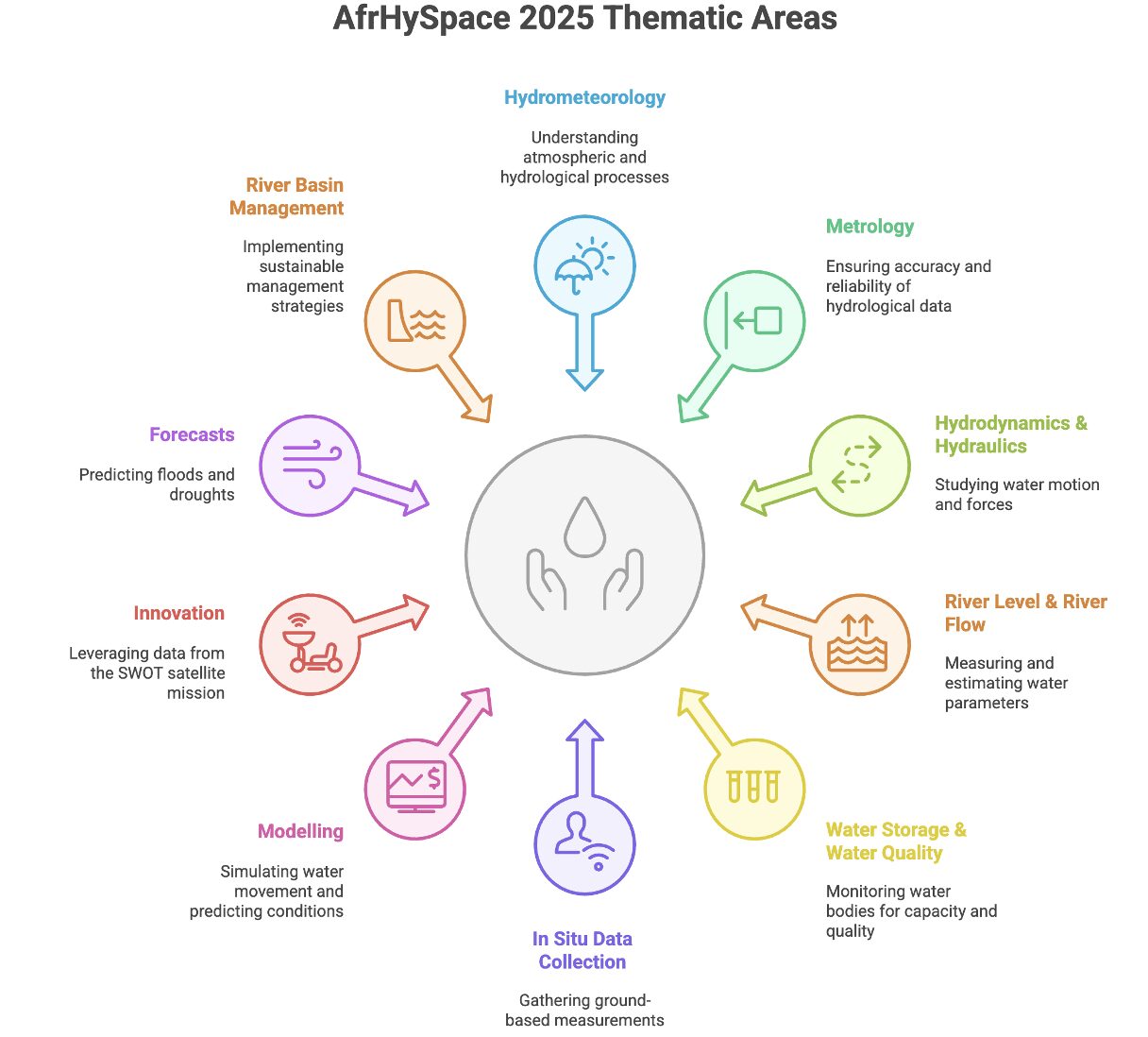
The programme is structured around several key components:
- Theoretical and Practical Training: Participants will receive foundational instruction in satellite remote sensing and space hydrology, and hands-on sessions in data processing, analysis, and hydrological modelling.
- Innovative Focus: The training will emphasise emerging technologies, including the Surface Water and Ocean Topography (SWOT) mission launched in December 2022, which provides high-resolution data on river discharge, lake-level variations, and other hydrodynamic parameters.
- Integrated Approach: The curriculum will address interconnected topics, including hydrometeorology, metrology, hydrodynamics, hydraulics, and river basin management. A dedicated field session in Dizangué, near Lake Ossa, will enable participants to conduct in-situ measurements and validate satellite-derived datasets.
Toward an African Water Intelligence Network
AfrHySpace 2025 represents a decisive step toward enhancing Africa’s hydrological intelligence. By fostering collaboration between African and international institutions, the initiative aims to reduce reliance on sparse or non-existent in-situ observations and to strengthen the continent’s ability to monitor, model, and manage its water systems using space-derived data.
Ultimately, the workshop seeks to advance the forecasting and mitigation of hydroclimatic hazards, including floods and droughts, and to improve evidence-based decision-making in support of the Sustainable Development Goals (SDGs), particularly those related to water security, food production, and climate resilience.
With participant selection already completed across multiple African nations, AfrHySpace 2025 stands poised to make a significant contribution toward building a more data-driven, water-secure, and resilient Africa.
Click here to get real time data and information on every Segments and players in the African space and satellite industry.