


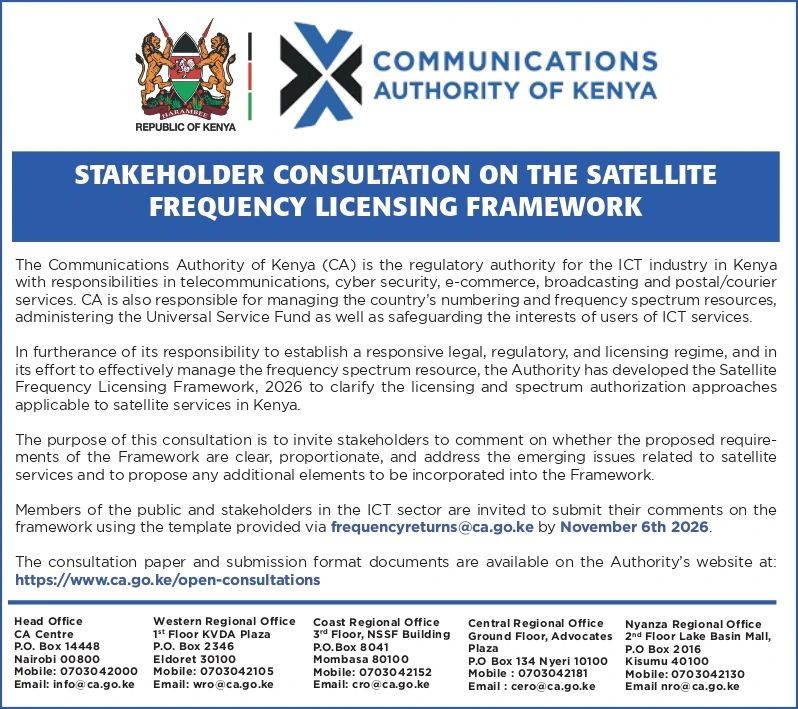
The Communications Authority of Kenya (CA) has launched a stakeholder consultation on a proposed Satellite Frequency Licensing Framework, inviting industry players, operators, and interested parties to submit their views on the proposed regulatory approach for satellite services in Kenya.
Purpose of the Consultation
The Framework has been developed to clarify the licensing and frequency spectrum authorisation approaches applicable to satellite services in Kenya. It responds to rapid developments in the satellite industry, including the deployment of high-throughput geostationary satellites, the emergence of non-geostationary orbit (NGSO) constellations, and the expansion of new services such as satellite-enabled Internet of Things (IoT) and direct-to-device connectivity.
The consultation invites stakeholders to comment on whether the proposed requirements are clear, proportionate, and adequately address emerging issues related to satellite services, and to propose any additional elements to be incorporated into the Framework.
Regulatory Context
The Framework is grounded in Kenya’s national legal framework, including the Kenya Information and Communications Act (KICA) CAP 411A, and aligns with the International Telecommunication Union’s Radio Regulations, to which Kenya is a signatory. It further aligns with the National ICT Policy Guidelines 2020 and the National Broadband Strategy 2018-2023.
Key Provisions of the Proposed Framework
The Framework addresses frequency spectrum authorisation across several categories of satellite services:
Fixed Satellite Services (FSS), covering Gateway Earth Stations, User Terminals, Very Small Aperture Terminals (VSATs), and Earth Stations in Motion (ESIMs) for aeronautical, maritime, and land-based applications.
Mobile Satellite Services (MSS), covering maritime, aeronautical, and land mobile satellite services operating on designated frequency bands.
Broadcasting Satellite Services (BSS), covering Direct-to-Home user terminals and ground stations for BSS feeder links.
The Framework also sets out licensing requirements under Kenya’s Telecommunications Market Structure, through which satellite-based communications services may be introduced in the country. Relevant licence categories include Landing Rights Authorisation, International Gateway Systems and Services Licence, Network Facility Provider Licence, Application Service Provider Licence, and Communications Equipment Distributor Licence.
Additionally, all electronic equipment used for service provision in satellite networks will be subject to type approval from the Authority, and licensed operators will be required to maintain records of all terminals in their networks and submit periodic compliance returns.
Consultation Questions
Stakeholders are invited to respond to ten consultation questions covering the scope and purpose of the Framework, the legal and regulatory basis, licensing requirements, frequency authorisation requirements for GSO and NGSO systems, type approval requirements, reporting obligations, and the overall implementation of the Framework.
How to Respond
Responses should provide reasons, supporting evidence, and practical alternatives where a different approach is proposed. Submissions should reference the relevant consultation question number and clearly identify any information considered confidential. Full details on submission methods and the closing date are available in the accompanying consultation notice on the Authority’s website.
For further information, visit the Communications Authority of Kenya’s open consultations page at www.ca.go.ke/open-consultations.
Click here to get real time data and information on every Segments and players in the African space and satellite industry.





 has launched a stakeholder consultation on a proposed Satellite Frequency Licensing Framework.)