


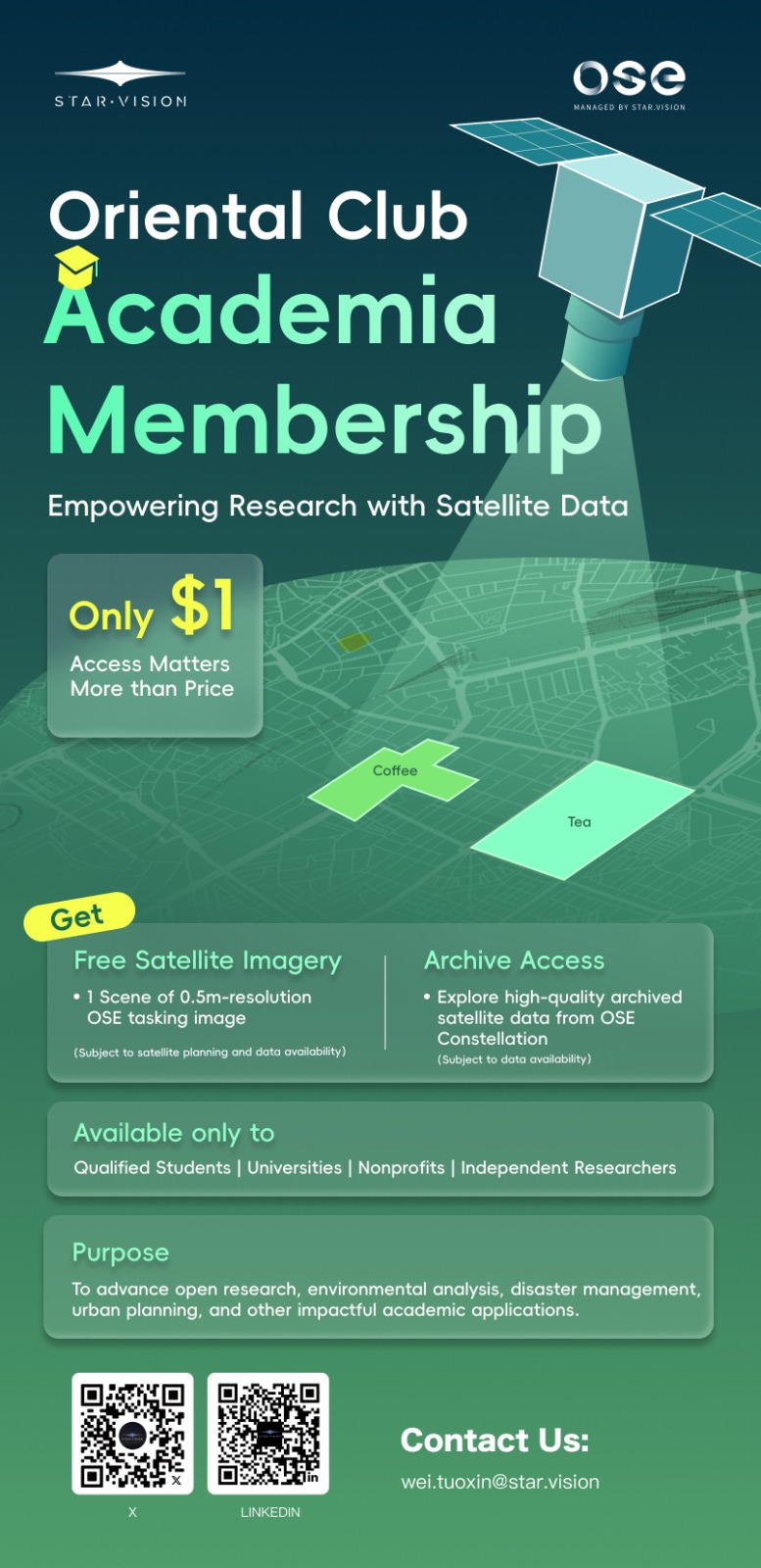
In an effort to empower research with satellite data, STAR.VISION Aerospace Group Limited has announced facilitated access to its collection of 50cm Very High Resolution (VHR) satellite imagery for members of academia and non-commercial researchers in Africa.
For a nominal USD 1 (one) per year, eligible academic and nonprofit users can now access tasking and archive imagery from the STAR.VISION managed OSE (Oriental Smart Eye) constellation. Named Oriental Academia Club, access to the data has been classified into two categories;
Benefit 1: One free 0.5m resolution tasking image (one scene). This will be provided based on the company’s internal tasking schedule, with delivery time not guaranteed but dependent on satellite availability and operational priorities.
Benefit 2: Access to historical archive database. This will be subject to existing data availability and the company’s review and approval process.
Membership in the Oriental Academia Club is uniquely aimed at qualified students, universities, nonprofits, and independent researchers across the continent, targeting non-commercial research applications in critical domains such as agriculture, climate change, environmental studies, disaster response, forestry, and land use and land classification.
How to Apply
Interested members of Academia and non-commercial researchers in Africa can reach out to the STAR.VISION team through;
- Name: Bruce Wei
- Email: wei.tuoxin@star.vision
More Information About the Oriental Smart Eye (OSE) Constellation
The Oriental Smart Eye (OSE) Constellation is a next-generation, real-time, intelligent satellite network composed of 252 satellites featuring a multi-fusion of optical, SAR, hyperspectral, and infrared sensors with diameters of 30cm and 50cm. Formally unveiled at Geospatial Week 2025 (GSW2025) in Dubai in April 2025, OSE satellites feature AI-driven in-orbit processing designed to deliver revolutionary precision for city management, disaster relief, environmental monitoring, and more.
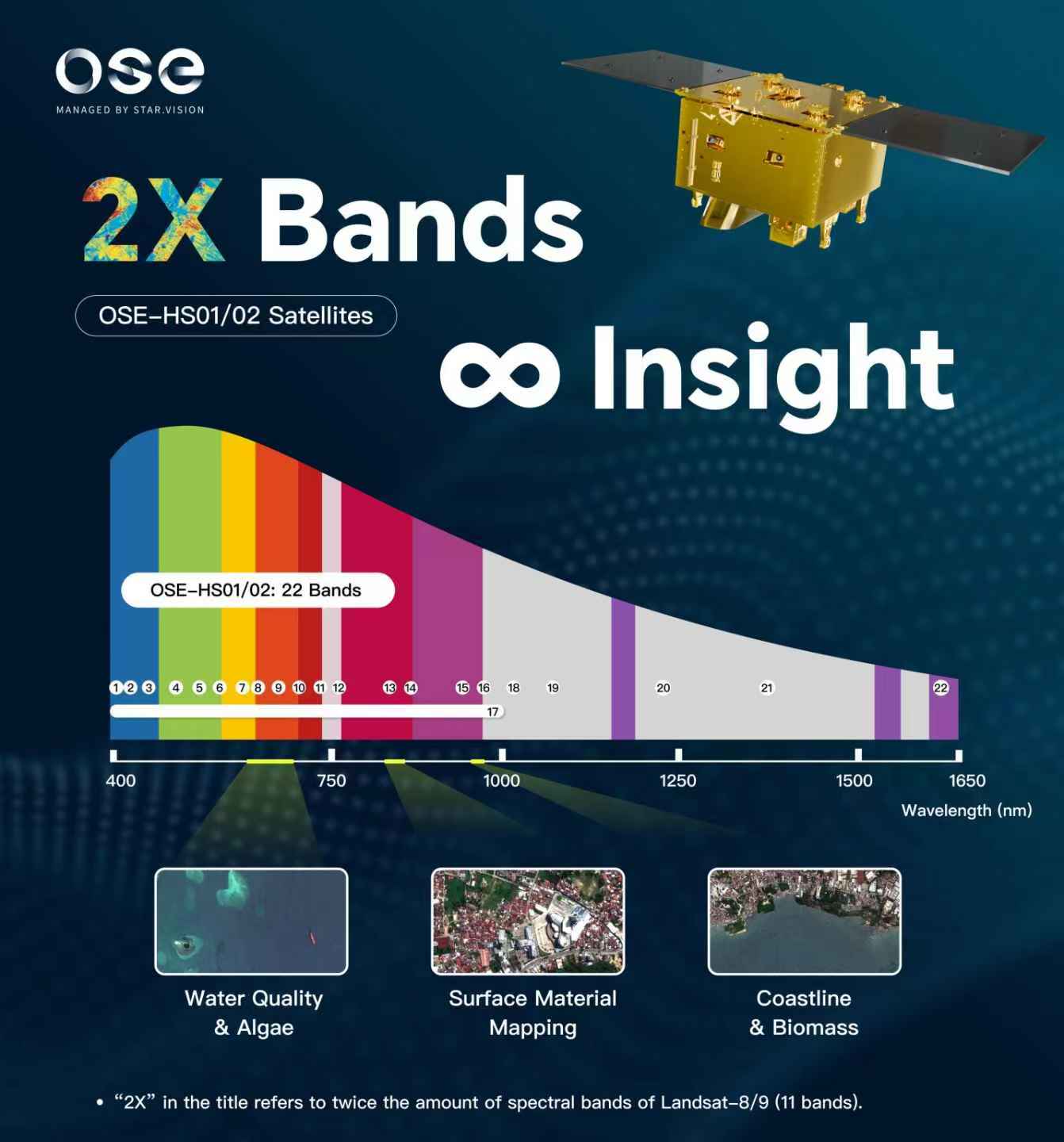
A highlight of the OSE constellation will be the VHR 50cm GSD hyperspectral imaging satellite named OSE-HS01/02. Data from the 22-spectral-band satellite, with a swath width of 300 km, will be particularly useful for researchers in areas that require versatile and highly detailed spatial data, such as mineral exploration, crop health monitoring, water management, soil analysis, and disaster response.
Bruce Wei, a representative of STAR.VISION in charge of the Oriental Academia Club membership stated, “By opening up access to our VHR satellite data, we hope to give researchers, students and communities a valuable resource to build innovative solutions in their own countries. The core objective is to encourage international collaboration by lowering barriers to entry for high-quality data, allowing researchers to focus more on analysis and spend less on data collection.”
Collaboration
STAR.VISION has, in the last two years, rolled out knowledge share programs in the area of AI application for space targeting members of academia, remote sensing organisations and space agencies in Africa, as part of the company’s initiative to share innovative solutions in spacecraft efficiency and enable global collaboration in satellite data application for real-life needs.
Click here to get real time data and information on every Segments and players in the African space and satellite industry.





 satellite imagery for members of academia and non-commercial researchers in Africa. )